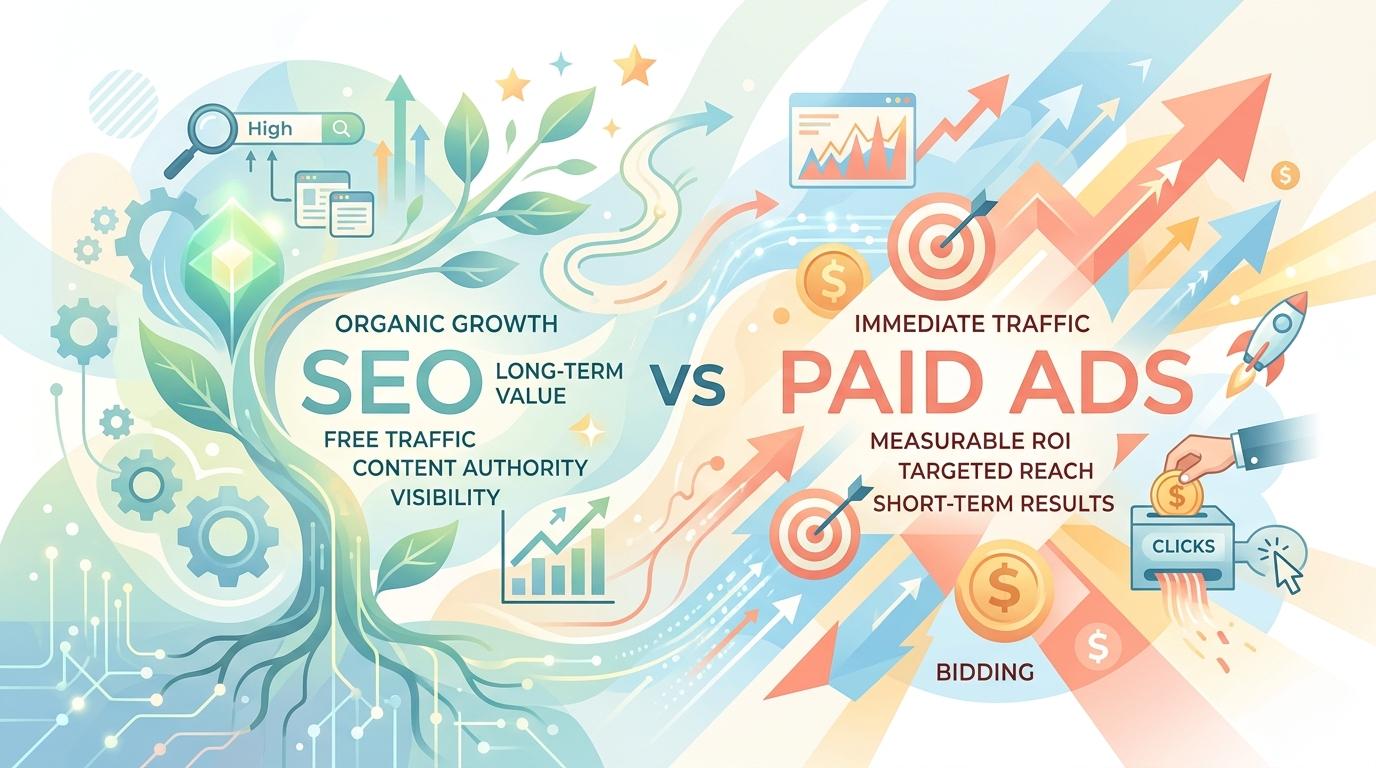
The question every marketer eventually has to answer honestly
You have a budget, a growth target, and two very different paths in front of you. Spend on SEO and build something that compounds over time, or put money into paid ads and get traffic today. Both work. But they work differently, cost differently, and pay off on completely different timelines.
The real answer is not about which channel is "better" in the abstract. It is about understanding what each one actually does to your ROI at the 3-month, 6-month, and 12-month mark, and then making a decision based on your stage of growth, your budget, and your goals.
Here is a clear-eyed breakdown of both channels, backed by current data.
How SEO and paid ads generate ROI differently
The mechanics of each channel are almost opposite, and that shapes everything about how you should think about return.
SEO builds an asset. Every piece of optimized content, every earned backlink, every technical improvement accumulates on your domain. SEO continues to deliver results long after the initial work is done. Unlike paid ads, which disappear the moment you stop paying, a strong organic presence keeps working in the background to bring in leads.
Paid ads rent attention. The moment your budget runs out, your visibility vanishes. SEO is best viewed as owning digital real estate, a long-term, high-value asset, while PPC is a rental model, offering immediate occupancy but requiring continuous payment.
That single structural difference explains most of the ROI gap between the two channels over time.
The ROI numbers: what the data actually shows
This is where the comparison gets specific, and the results may surprise you depending on the timeframe you use.
SEO delivers better long-term ROI with an average return of $22 for every $1 spent, while paid ads typically return $2 to $4 per dollar. However, paid ads bring immediate results while SEO takes 3 to 6 months to start working.
Research drawing on campaign data through Q3 2025 puts the median SEO ROI at 748%, meaning businesses generate $7.48 back for every dollar invested. High-value sectors like medical devices and manufacturing perform even higher. By contrast, Google Ads delivers an average ROI of around 200%, or roughly $2 for every $1 spent, a solid return for short-term campaigns, but a fraction of what organic delivers over time.
The timeline matters enormously here. SEO that returns 2:1 in year one and 15:1 by year three is a better investment than paid search at a stable 3:1, if you can afford to wait.
SEO surpasses PPC ROI within 9 to 12 months. PPC wins in the first 3 to 6 months. After 9 to 12 months, SEO overtakes PPC and continues growing.
Cost per lead: the number most marketers overlook
ROI percentage is one metric. Cost per lead is another, and it is often the one that changes minds fastest.
Organic leads cost $31 each on average. PPC leads cost $181 each. SEO generates leads at 5.8 times lower cost than paid search.
That gap widens in competitive industries. 87% of industries saw their cost-per-click rise in 2025, with high-stakes sectors like legal services reaching $131.63 per lead. The PPC auction model is inherently inflationary. More competitors entering a space means higher bids, which means your cost per acquisition keeps climbing regardless of how well your ads perform.
SEO does not work that way. Once a page earns a strong organic ranking, that traffic carries no incremental cost per click. The cost curve moves in the opposite direction over time.
Conversion rates: intent is everything
Here is where the comparison becomes more nuanced, because raw conversion rate data can be misleading depending on how you read it.
Businesses that prioritize SEO can achieve up to 14.6% close rates from organic leads, far outpacing the 1.7% from outbound methods like ads. The reason is straightforward: organic searchers are actively looking for what you offer. They arrive with context, intent, and a degree of trust already built in.
Organic traffic converts at a significantly higher rate than paid traffic. The average conversion rate for SEO is 2.4%, nearly double the 1.3% average for PPC. This gap is driven entirely by consumer trust. Users are highly skeptical of paid advertisements.
That said, PPC has a real advantage in one specific scenario: high-intent, bottom-of-funnel searches with precise landing page targeting. Visitors from PPC ads are 35% more likely to convert than those from SEO in certain contexts, because PPC campaigns allow for precise targeting with specific keywords and tailored ad copy, guiding highly motivated users directly to optimized landing pages.
The honest takeaway: organic wins on volume and long-term conversion cost. Paid wins on speed and targeting precision for specific, time-sensitive campaigns.
Where paid ads have a genuine edge
A fair comparison does not ignore what paid advertising does well. There are real situations where PPC is the right tool.
- You need results this month. PPC provides immediate market visibility and rapid validation, making it highly effective for short-term revenue generation, product launches, and startup validation.
- You are testing a new offer. PPC allows you to try out different keywords before spending months or years investing in them through SEO.
- You are running a seasonal campaign. Paid ads give you exact control over spend, timing, and targeting in ways organic search simply cannot match on a short window.
- Your organic presence is not yet established. In a new market or with a new domain, paid ads fill the visibility gap while SEO builds momentum.
The problem only arises when businesses rely on paid ads exclusively and never build the organic foundation underneath. When you rely only on paid ads, you are renting your visibility, not building it. The moment you stop paying, the leads stop coming.
What the numbers say about organic vs. paid search
Organic search drives 53.3% of all website traffic. More than half of all website visits come from organic search. Paid search accounts for roughly 15% to 27% depending on the sector. The volume gap alone makes a compelling case for prioritizing organic over time.
Over 70% of users say they trust organic results more than paid ads. That trust translates directly into lower friction, better engagement, and higher lifetime value from organic customers.
49% of marketers identify organic search as the top ROI-driving channel, with organic search beating paid ads, social media, and email marketing as the highest-ROI channel in marketer surveys.
And the cost trend is moving in one direction for paid: the average cost-per-click for Google Ads has risen by 18 to 25% year over year in competitive fields like tech, healthcare, and finance. That trajectory does not reverse.
© fahad.oracrondigital.com
The smartest approach: how to combine both channels
The strongest digital marketing programs do not treat this as a binary choice. They use each channel for what it is genuinely good at.
The most profitable digital marketing strategies do not choose between SEO and PPC. They integrate both channels, typically allocating 75% of the budget to long-term organic growth and 25% to targeted paid acquisition.
A practical framework by business stage:
- Early stage or new website: Lead with paid ads to generate immediate revenue. Invest simultaneously in foundational SEO so the organic engine starts building from day one.
- 6 to 12 months in: SEO begins to deliver meaningful organic traffic. Shift budget gradually. Use paid ads to target gaps, test new offers, and dominate high-value keywords where you are not yet ranking organically.
- 12 months and beyond: After 12 months, organic search becomes 5 to 10 times more cost-effective than paid search. At this point, a 70/30 or 80/20 split in favor of SEO typically makes more financial sense, with paid reserved for seasonal pushes and new market testing.
Marketers using both organic SEO techniques and PPC advertising saw around 25% more clicks and 27% more profit than those who only used one channel. The compounding benefit of appearing in both organic and paid results for the same search is real and measurable.
One more factor worth watching in 2025: emerging technologies like Generative Engine Optimization (GEO) are increasing the value of SEO, as AI chatbots heavily rely on high-ranking organic content to answer user queries. The brands that own organic authority today are the brands that get cited in AI-generated answers tomorrow. That is a new layer of visibility that paid ads simply cannot buy.
"Paid ads are renting visibility. SEO is owning it. In 2025, the savviest businesses are doing both to thrive."
FAQ
Is SEO or paid ads better for a brand-new website?
For a brand-new website with no organic authority, paid ads are the faster path to initial revenue. They generate traffic within hours and let you validate offers and keywords before committing months to SEO. That said, starting SEO from day one alongside your paid campaigns shortens the timeline to organic growth significantly. The two are not mutually exclusive, and starting both early gives you the most flexibility as your budget evolves.
How long does it take for SEO to deliver a positive ROI?
SEO typically surpasses PPC ROI within 9 to 12 months. PPC wins in the first 3 to 6 months, but after the 9 to 12 month mark, SEO overtakes PPC ROI and continues growing. Evaluating SEO over a short window consistently understates its value, because the compounding benefit of accumulated rankings and authority is not visible in the early months.
Why does organic search convert at a higher rate than paid ads?
Organic rankings signal to the user that Google considers your site an authoritative, credible source. That implicit endorsement reduces skepticism and friction in the buying process. Earning a top organic ranking signals to the user that Google considers the website an authoritative, credible source. This implicit endorsement reduces friction in the buying process. Users who land on your site from organic search have typically done more research, arrive with stronger intent, and are less price-sensitive than users clicking a paid ad.
What is a realistic budget split between SEO and paid ads?
It depends heavily on your stage of growth and how urgently you need leads. A common framework: businesses in year one often split 50/50. By year two, as organic traffic builds, a 70% SEO and 30% paid split becomes more cost-effective. By year three, many mature programs run at 80% SEO and 20% paid, with paid reserved for strategic campaigns rather than ongoing traffic generation. Always let your own performance data drive the final allocation rather than any fixed ratio.
Does paid advertising help SEO performance?
Not directly in the ranking algorithm, but paid ads do support SEO in indirect ways. PPC campaigns give you fast keyword validation data, helping you identify which terms convert before investing in organic content for them. There is a compounding value to being seen by prospective customers in both the organic and paid search results, for the same reason that being seen in both the search results and on social media is beneficial to companies. Running both channels simultaneously can also build brand familiarity, which improves organic click-through rates over time.