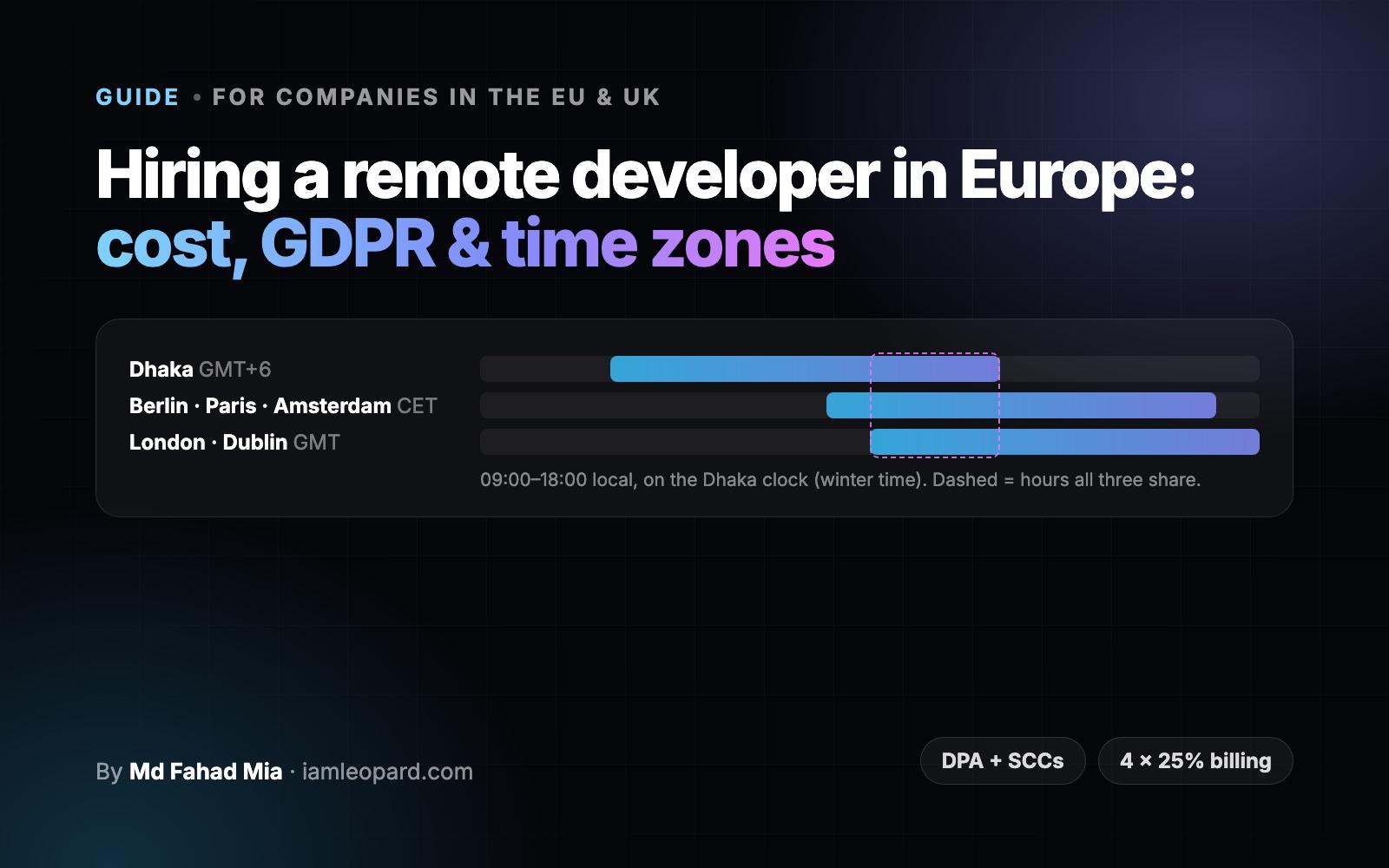
The short answer: a European company can hire a senior remote developer outside the EU legally and safely, as long as three things are in place. A GDPR data processing agreement with Standard Contractual Clauses when personal data is involved. A contract that sets out who owns the code. And a payment schedule that ties money to finished work. From Dhaka, where I work, you also get three to five shared working hours a day with Central Europe and the UK.
I am Md Fahad Mia, a software and AI engineer in Dhaka, Bangladesh. I build web apps, backends and AI features for companies abroad, and I bill fixed-price projects in four milestones: 25% after each 25% of the work is finished, with no deposit. This guide is written for founders and CTOs in the EU and the UK weighing a remote hire against a local one.
Why European companies hire remote developers
Mostly because the local market is short of engineers. Eurostat counted 10.45 million ICT specialists employed in the EU in 2025, about 5% of all jobs, and growth has slowed to 2.6% a year. The EU's own State of the Digital Decade 2026 report puts the gap to its 2030 target of 20 million at roughly 9.5 million people. In Eurostat's survey of hard-to-fill vacancies, 57.5% of EU businesses that tried to recruit ICT specialists said they struggled to fill the roles.
Germany shows both sides of the picture. Bitkom counted 79,000 unfilled IT jobs in September 2026, down from 149,000 in 2023. The shortage has halved in three years and is still large. For a startup or a 30-person company, it shows up as months of searching and then a salary that cannot compete with the big employers.
What a developer costs in Europe, and remotely
Here is what the market charged in 2026, from the most recent survey for each country. Freelance rates exclude VAT.
| Market | Freelance or contract rate | What one 40-hour week costs | Source |
|---|---|---|---|
| Germany (DACH) | €90 an hour for software and web development, €95 IT median | €3,600 to €3,800 | freelancermap Freelancer-Kompass 2026 |
| Netherlands | €94 an hour average for self-employed software developers | about €3,760 | Knab ZZP rate survey 2026 |
| United Kingdom | £525 a day median for software developer contracts | about £2,625 | IT Jobs Watch, September 2026 |
Employing someone costs more than the salary. levels.fyi puts median total pay for a senior software engineer at about €96,000 in Germany and €110,000 in the Netherlands, though its data leans towards larger tech employers. In Germany, employer social contributions add about 21% of gross pay on top, up to the contribution ceilings, before recruiting fees, equipment and the months the seat stays empty.
Comparing like with like
Hourly rates are the wrong comparison, because they buy time rather than outcomes. The honest question is what a finished result costs and who pays when the estimate slips.
| Option | What you buy | Who carries the overrun risk |
|---|---|---|
| Senior employee | A long-term team member, after a long search | You, as fixed cost |
| Local freelancer, hourly | Hours at €90 to €95, or £525 a day | You |
| Agency | A team and a formal process | Usually you, through change requests |
| Remote senior engineer, fixed price | A defined outcome: from $3,000 for backend, $3,500 for web, $5,000 for AI and automation | The engineer, paid 25% per finished milestone |
For many small European teams the right answer is a mix: a small core in-house team, plus a senior remote engineer for the builds they cannot staff fast enough.
Time zones, and how many hours you actually share
Bangladesh runs on GMT+6 all year, with no daylight saving. Europe moves its clocks twice a year, so the gap changes with the season.
| Your city | Hours behind Dhaka (winter / summer) | 09:00 your time is, in Dhaka | Shared hours, 09:00–18:00 both sides |
|---|---|---|---|
| London, Dublin, Lisbon | 6 / 5 | 15:00 / 14:00 | 3 / 4 |
| Berlin, Paris, Amsterdam, Madrid, Stockholm, Warsaw | 5 / 4 | 14:00 / 13:00 | 4 / 5 |
| Helsinki, Athens, Bucharest | 4 / 3 | 13:00 / 12:00 | 5 / 6 |
In practice that means your morning stand-up is my early afternoon, and anything you raise before lunch gets an answer the same day. The time difference also works for you. My morning is your night, so a bug you report at the end of your day can be fixed before your next one starts. The habits that make it work are dull ones: a written update after every working session, a shared board, and decisions recorded where your whole team can see them.
GDPR when your developer is outside the EU
This is the question that stops most European companies, and the answer is manageable. Bangladesh has no EU adequacy decision, and under the EDPB's Guidelines 05/2021, a processor in a third country that remotely accesses personal data stored in the EU is making a transfer, even if the data never leaves your servers. So when a project touches personal data, the transfer needs a legal basis. For a contractor, that basis is the Commission's Standard Contractual Clauses.
In practice, this is the setup I work under:
- A data processing agreement under Article 28 GDPR, which sets out exactly what I may do with your data, and nothing more.
- Standard Contractual Clauses, Module 2 (controller to processor), attached to it. On your side, that comes with a short transfer impact assessment.
- Your data stays in your EU-region accounts. I work inside your cloud with least-privilege access you can revoke at any time. Nothing is copied to my machines.
- Synthetic or pseudonymised data for development. Most of a build can be done and tested without a single real customer record.
The last two points matter most, because the cleanest transfer is the one that never happens. If your project involves AI, the model provider is a second transfer question, which I cover in GDPR-compliant LLM integration.
Contracts, invoices and VAT
- VAT. Business services from a supplier outside the EU are taxed where the customer is established (Article 44 of the VAT Directive), and the customer accounts for the VAT under the reverse charge (Article 196). My invoices carry no EU VAT, and your finance team self-accounts for it. UK businesses do the same under HMRC's reverse charge.
- IR35, for UK companies. HMRC's own Employment Status Manual says a worker who is not UK resident and works outside the UK is unlikely to fall within UK tax or National Insurance, and where they do not, the off-payroll rules do not apply. So IR35 generally does not bite on a contractor working from Dhaka. Take advice for edge cases, such as long working visits to the UK.
- Payment terms. The EU Late Payment Directive sets a 30-day default for business invoices when the contract is silent, and caps agreed terms at 60 days unless expressly agreed and not grossly unfair. In the UK, the Small Business Protections Bill introduced in May 2026 proposes a similar 60-day cap. It is not law yet.
- Code ownership. The contract should say plainly that the code belongs to your company, and the repositories should sit in your organisation from the first commit.
- Payment schedule. I bill fixed-price projects in four equal milestones and invoice each 25% only after that quarter of the work is finished and reviewed. There is no deposit. Details in how the 4 × 25% model works.
How to vet a remote developer before you sign
- Production proof, not portfolio screenshots. Ask what is live, what traffic it handles and what broke along the way. My flagship is the Tryneth backend: about 180 API endpoints, five orchestrated AI agents, usage-based billing and row-level security on 97 of 98 tables.
- A written plan before any money moves. Scope, milestones, acceptance criteria, a fixed price. If you cannot get this in writing, the project will drift.
- Payment tied to finished work. The strongest signal of confidence is an engineer who is paid after delivery, not before. My 4 × 25% milestone model exists for exactly that reason.
- Code ownership in your name. Your repositories, your cloud accounts, your API keys, from day one. No black box.
- A data answer that goes beyond "we are GDPR compliant". Ask where your data will live, who can reach it and under which contract. The right answer names a DPA, SCCs and your own EU region.
- Clear writing. Remote work lives in writing. Their first written plan tells you what every weekly update will look like.
Where I fit
I work best with small and mid-sized teams in Europe and the UK that need one senior engineer who owns the outcome: an AI feature that has to work on real customer data, a backend that has outgrown its first version, or a product built from zero. Projects start at $3,000 for backend work, $3,500 for web and $5,000 for AI and automation, all listed on the services page. Each is paid in four equal milestones after the work is finished. If you are adding AI to a product, read GDPR-compliant LLM integration and what the EU AI Act means for small businesses next.
Questions European companies ask before hiring remotely
Can an EU company legally hire a developer based in Bangladesh?
Yes. You contract them as an independent business, not as an employee, and they invoice you for services. If they will access personal data of people in the EU, you add a GDPR data processing agreement with Standard Contractual Clauses, because Bangladesh has no EU adequacy decision.
Do we need Standard Contractual Clauses if the developer only accesses our EU servers remotely?
Usually, yes. Under EDPB Guidelines 05/2021, remote access to EU-stored personal data from a third country counts as a transfer. If the developer works only with synthetic or anonymised data and never touches personal data, there is no transfer to cover, which is why I build that way wherever possible.
How many working hours overlap between Dhaka and Europe?
With a 09:00 to 18:00 day on both sides, about four hours a day with Central European Time in winter and five in summer, three to four with the UK, Ireland and Portugal, and five to six with Finland, Greece and Romania. Bangladesh has no daylight saving, so the gap shifts by an hour when Europe changes its clocks.
Will your invoices include VAT?
No EU or UK VAT is charged. For business clients, services from a supplier outside the EU or the UK are generally covered by the reverse charge, so your own finance team accounts for the VAT. Your accountant confirms the treatment for your company.
Does IR35 apply if a UK company hires you?
Generally not. HMRC guidance says a worker who is not UK resident and works outside the UK is unlikely to be chargeable to UK tax or National Insurance, and then the off-payroll working rules do not apply. Edge cases, such as long periods of work in the UK, deserve advice.
How do payments work for European clients?
Fixed-price projects are split into four equal milestones. I invoice 25% only after each 25% of the work is finished and you have reviewed it, so there is no deposit and you never pay for work you have not seen. Payment is by bank transfer, Wise or card through Stripe.
Hiring a remote engineer for a European team
If you are in the EU or the UK and weighing a remote hire, a scoping call costs nothing and ends with a written plan, a fixed price and four milestones you only pay for once they are done. See what hiring me looks like, or start a project today. I read and answer every message myself.