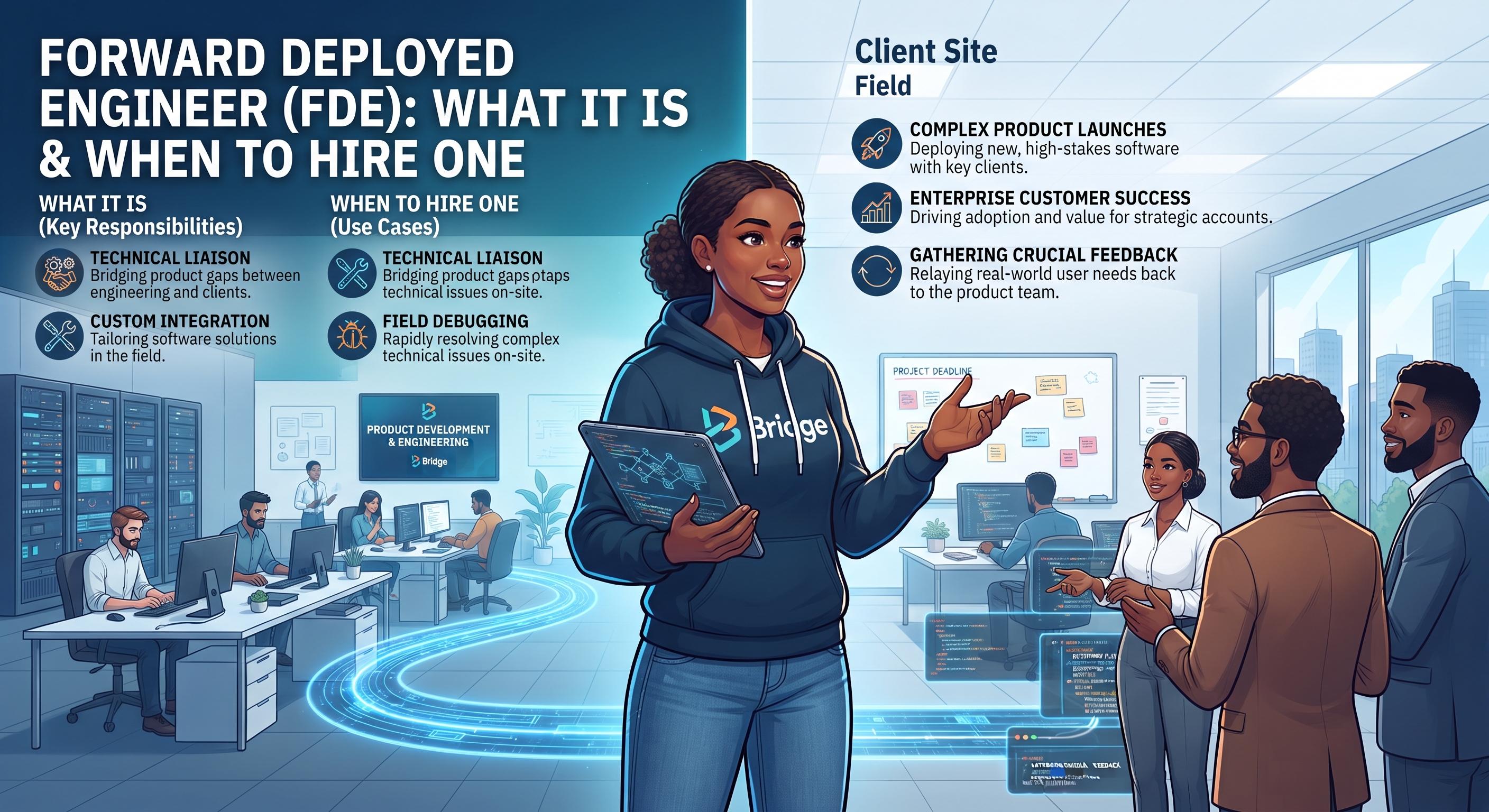
What a forward deployed engineer actually does
A forward deployed engineer is a senior software engineer who embeds with a customer's team, learns how the business really runs, and ships production software inside that environment. Nothing is handed over from the outside. The engineer sits with you and builds. The title came out of Palantir, where engineers sat with clients for months at a time. OpenAI, Anthropic, Databricks and Stripe hire for it now, and so does a growing number of small companies that need AI working in production rather than in a demo.
I work as one. For the past few years I have been the person who joins a founder or an operations team, maps the data model, wires the AI features and the backend around it, and stays until the whole thing holds up under real traffic. So this is the view from inside the role, written for the people who might hire a forward deployed engineer, not for people applying to be one.
Three things that separate the role from a regular developer
- Ownership of the outcome. A developer closes tickets. This engineer owns the result, from the first scoping call to the monitoring dashboard after launch.
- Proximity to the business. The work happens in your Slack, your database and your weekly operations meeting. Requirements come from watching people work, not from a document written three months earlier.
- Production as the finish line. The job is not done at the prototype. It is done when the feature runs for real users with logging, guardrails and a handover your team can operate.
Why forward deployed engineers are suddenly everywhere
Because AI projects fail at the integration, not at the model. MIT's Project NANDA studied 300 public AI deployments in 2025 and found that 95 percent of generative AI pilots produced no measurable effect on profit and loss. The few that worked were built close to the daily workflow. Tools built with an external partner reached production about 67 percent of the time. Tools built entirely in house managed roughly 33 percent.
Hiring followed the failures. An analysis by Indeed and the Financial Times counted an 800 percent jump in forward deployed engineer job postings between January and September 2025. The curve kept climbing through 2026. This is not just a big company trend either. One review of 1,000 FDE job posts found that 59 percent came from companies between seed and Series A. Small teams with paying customers and no time to babysit an AI pilot are the ones doing the hiring.
What changed for small businesses
Two years ago the question was should we try AI at all. Now the questions are sharper. Why does the chatbot the agency delivered give the wrong answer about refunds? Why does the summary feature cost $900 a month in tokens? Why can nobody on the team change either one? Those are forward deployed engineering problems. They live between the model and the business, and they need one person who understands both sides.
Forward deployed engineer or agency, which fits a small business
Pick the forward deployed engineer when the work touches your live systems and you want the knowledge to stay inside your company. Pick an AI development agency when you need many hands working in parallel and you value formal process over individual seniority. Pick a freelance developer when the task is small, clearly specified and low risk. Here is how the three compare on the things that decide a project.
| Question | Forward deployed engineer | AI development agency | Freelance developer |
|---|---|---|---|
| Who does the work | One senior engineer, start to finish | A team, often more junior than the person who scoped it | One person, seniority varies widely |
| Where the work happens | Inside your systems, next to your team | In their environment, delivered to yours | Wherever the ticket says |
| Who owns the knowledge afterwards | You, through code, documentation and handover | Mostly them, unless you pay for transfer | Often nobody |
| Typical cost shape | Fixed project from about $5,000, or a monthly retainer | $20,000 to $80,000 for a small custom AI build | $50 to $180 an hour by country and seniority |
| Time to a working version | Days to two weeks | Weeks, after discovery and design phases | Depends entirely on the brief |
| Best for | AI features and backends that must survive production | Large parallel programs with formal process | Prototypes, scripts and one-off fixes |
The honest case for an agency
If you need a mobile app, a marketing site, a data pipeline and an AI assistant all shipped this quarter, one engineer cannot do that alone. Agencies exist for parallel work, and good ones are worth it. Where they struggle is the narrow, deep problem, such as making an AI feature safe on top of messy customer data. That problem wants one accountable person sitting next to the data.
The demo is the easy part. You hire a forward deployed engineer for everything that happens after the demo, when the feature meets real data, real permissions and real users.
That is the whole argument of my note on where AI features should live inside a product, because the place a feature shows up decides whether anyone still uses it after the first week.
What does a forward deployed engineer cost
A full time forward deployed engineer in the United States has a median salary of roughly $183,000 to $190,000 before equity. Offers from the frontier AI labs run far higher. Almost no small business should put that role on payroll. The contract version is what makes the model work for a company with 5 to 50 people.
Three ways to buy the work
- A scoped project. One outcome, one price, one timeline. My AI and automation projects start at $5,000, web builds at $3,500 and backend and API work at $3,000, with the real quote set after a short scoping call. Agencies quoting the same small AI build usually land between $20,000 and $80,000.
- A monthly retainer. A fixed number of embedded days per month, so the engineer stays close to the product after launch. This is the nearest thing to a fractional forward deployed engineer, and it is how most of my longer client relationships run.
- Hourly. Fine for audits and short fixes. Senior freelance engineers in the United States, the United Kingdom, Australia and Canada charge $80 to $180 an hour. An engineer with the same stack based in Dhaka or Lisbon often charges a third to a half of that for identical output. That is why my prices are benchmarked to international rates rather than local ones.
The costs people forget
Model usage is a real line item. A support assistant handling 1,000 questions a day costs roughly $200 to $300 a month in API calls at current prices. A careless prompt can triple that. Budget 15 to 20 percent of the build cost per year for maintenance, model upgrades and prompt fixes. A good FDE shrinks both numbers. Tight context and caching are exactly the unglamorous work the role exists for. On one production endpoint I cut about 10 million uncached tokens, and it showed up on the bill the same month.
How an engagement runs, from first call to production
The shape below is the one I use, and it is boring on purpose. Calm projects come from rhythm, not heroics, which is the point of my note on how I keep freelance projects calm.
- Scoping call. Goals, users, constraints, and the systems already in place. We write down what done looks like before any code exists.
- Written plan, usually within a week. Data model, integration points, the AI features worth building and the ones that are not, a timeline and a price.
- Milestones of one to two weeks, each with a working preview. You see the real thing early, so a course correction costs an afternoon instead of a month.
- Production hardening. Access control at the database level, monitoring, rate limits, evaluation of the AI outputs against real cases, and a rollback path. On the Tryneth backend that meant row-level security on 97 of 98 tables and orchestration of five AI agents with usage-based billing that cannot double charge.
- A handover you own. Documented code in your repositories, your cloud accounts, your API keys. No black box that only I can touch.
- Support after launch, if you want it. A retainer or an on-call arrangement, so the feature keeps improving as your data changes.
The Tryneth case study shows what that looks like on a multi-tenant SaaS backend with about 180 API endpoints.
Signs you need one, and signs you do not
You probably need one when
- You have paying customers and a real database, and the AI feature has to work on that data, not on a clean sample.
- An agency or a no-code tool got you to a demo, and the demo has been almost ready for three months.
- Nobody on your team can safely change the prompt, the model or the integration once the vendor leaves.
- The feature touches money, permissions or customer communication, where a wrong answer has a price.
- You want the knowledge to stay in your company, in code you own.
You probably do not need one when
- You are still validating the idea. A prototype from a freelance developer, or a weekend with a no-code builder, is cheaper and faster.
- The work is broad and parallel, five products at once. That is agency territory.
- You already have a strong in-house team and only need a second opinion. A short architecture review is enough, and I offer that on its own.
Questions people ask before hiring a forward deployed engineer
What is the difference between a forward deployed engineer and a software engineer?
A software engineer builds the product for every user and works inside the vendor's own team. A forward deployed engineer builds for one customer, inside that customer's environment, and owns the outcome through production. Same technical skills, different place to stand. Palantir coined the title for engineers who worked on site with clients for months.
Is a forward deployed engineer the same as a solutions engineer or a consultant?
No. A solutions engineer supports the sales process and rarely ships production code. A consultant writes the recommendation and leaves. An FDE writes the recommendation, builds it, deploys it and stays accountable when it meets real data. If the person you are hiring will not own code in your repository, it is a different role.
Can a small business hire a forward deployed engineer on contract?
Yes, and for most companies under 50 people it is the only sensible way. Full time FDE salaries in the United States sit near $183,000 to $190,000 before equity. On contract you buy the same seniority as a scoped project from about $5,000, or as a monthly retainer, and you keep the code either way.
How long does a forward deployed engineer engagement last?
A single AI feature or backend project usually runs three to eight weeks in my experience, delivered in one to two week milestones with a working preview at each step. Retainers then run month to month. If someone quotes six months before you see anything working, treat that as a warning sign rather than a plan.
How much does it cost to hire a forward deployed engineer?
On contract, expect a fixed price from around $5,000 for a scoped AI or automation project, $3,000 to $3,500 for backend or web work, or a monthly retainer for ongoing embedded days. Compare that with $20,000 to $80,000 for a small custom AI build at an agency, plus $200 to $300 a month in model usage for a busy assistant.
Do I need an in-house developer before hiring a forward deployed engineer?
No. The role exists for teams that do not have one yet. What you do need is someone on your side who can make quick decisions about scope and data access, usually the founder or an operations lead. The handover is written so a future hire, or a different engineer, can pick the system up without me.
Want an engineer who ships the AI, not the slide deck
Is your AI feature stuck between demo and production? Are you about to sign an agency quote that feels heavy for the size of the problem? Talk to me first. It starts with a scoping call. A written plan with a price follows, and you decide from there. See what hiring me looks like, or start a project today.
You can browse everything I build under services, and read how I approach AI and automation in particular. The case studies and my career page hold the proof. When you are ready, get in touch. I read and answer every message myself.